
How CBT works
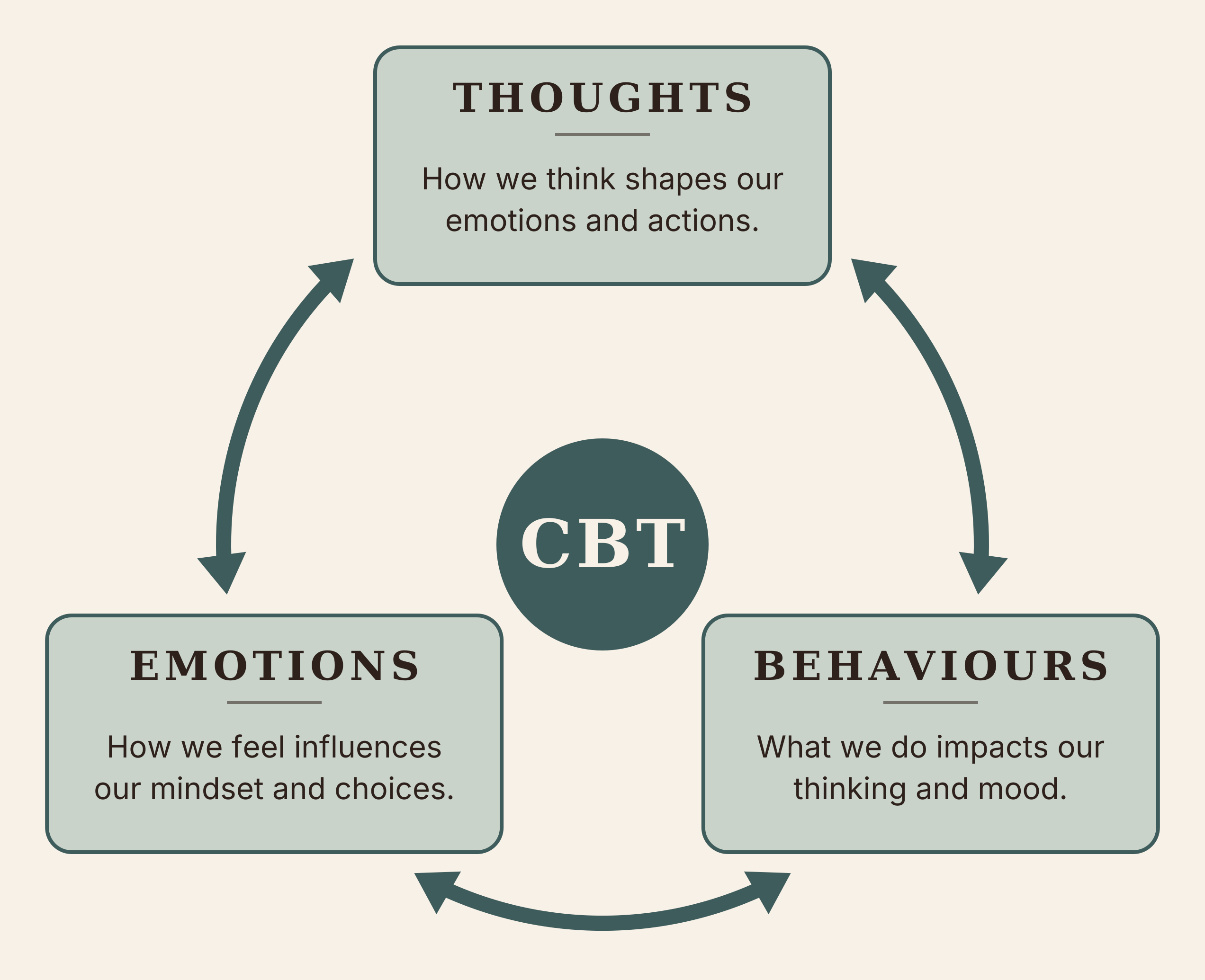
Cognitive Behavioural Therapy (CBT) can help us understand what’s happening between our thoughts, emotions and behaviours. When life feels overwhelming, our thoughts, feelings, physical sensations and behavioural responses can get caught in a loop, leaving you feeling stuck or exhausted.
In CBT, we explore these patterns and loops with curiosity and kindness, agreeing on small steps towards what matters to you.
CBT is about the connections between:
- What goes through your mind
- How you feel in your body and
- What you do next
We also consider your circumstances and past experiences, so we can understand the bigger picture about where, when, with whom and what we think, feel and behave. The following diagrams show this more visually:
Our brains are designed to protect us, which is why we respond in ways that bring relief in the moment, but sometimes we fall into patterns we start to believe are helpful to us in some way that make difficulties harder to move on from or manage.
In CBT therapy, these patterns help us recognise an automatic response and understand its purpose. Then we can consider other ways to respond that break the pattern while still meeting the brain’s instinct for protection.
Let’s consider the following:
A friend has not replied to a message.
You might wonder:
A: “Did I do something?”
You might also wonder:
B: “Are they having a bad day?”
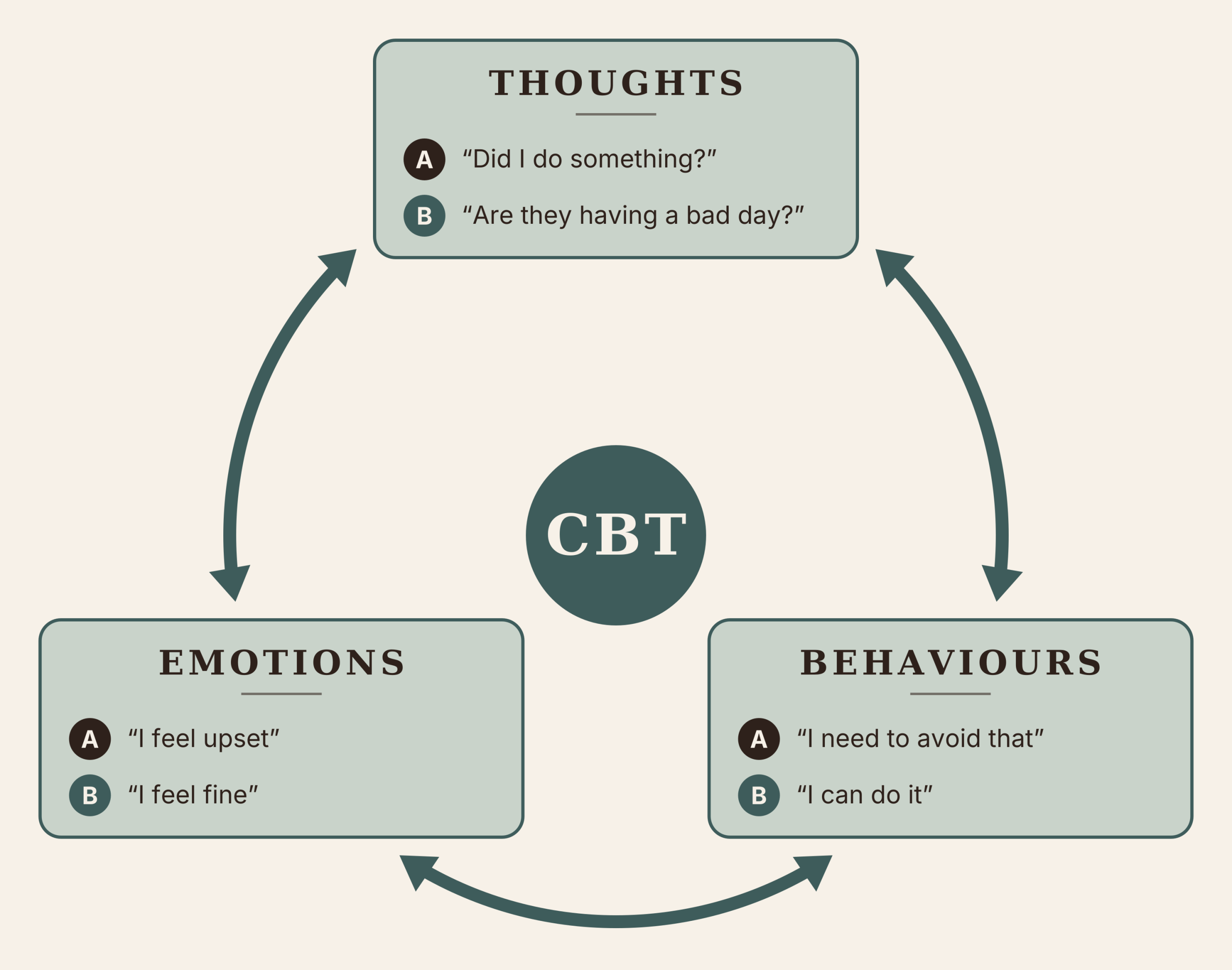
If our immediate (automatic) response is A, that’s our brain choosing self-protection first, doing its job. We also know that B is possible. But we can get stuck in loops of thoughts and feelings about A, and these loops can pull our attention to our own flaws, shortcomings and perceived defects, and shape how we behave with this friend and in other relationships. Over time they can start to feel like a downward spiral that never ends.
CBT can help us see the loops for what they are, or where they may have been helpful or necessary at a point in our lives. Therapy can help find new ways to take back control of our thoughts, emotions, physical sensations and behaviours in real time.
A gentle step forward
If this example feels familiar, or you recognise a loop of your own, we will look at the context together. We will think about what is known and what is not, and agree a reasonable way to explore it.
We’ll plan these steps carefully, including anything that feels difficult, and review what changes you notice between sessions. Therapy aims to build your understanding and confidence, with room to pause, reflect and adjust rather than feeling pressured to get everything right.
I offer online video and telephone sessions for adults living in England. A Foundation Session gives us space to talk about what’s been difficult and what you would like support with.
Making CBT accessible
For me, accessible means CBT that is easy to approach, easy to understand and easy to fit into your life. That’s what I mean by therapy shaped around you.
Where and how we meet
Sessions are offered online or by telephone, so you can talk from somewhere that feels comfortable and convenient.
Clear, down-to-earth language
I explain CBT in plain terms, and we use simple visual maps, which I call Reaction Loops, to see what keeps a difficulty going and where change might be possible.
Your pace, your priorities
We agree together what to focus on and how quickly to move, and we adjust as we go.
A gentle first step
A Foundation Session gives us time to talk about what has been difficult and what you’d like to work on, before you decide whether to continue.
Support between sessions
You’re welcome to explore the resources on this website whenever they help, from interactive CBT strategies to reading and videos.
If you’re wondering whether this might suit you, the Areas of Support and Limits & Support pages explain what I can support you with, who I can help and when other support may be a better fit. When the time feels right, you’re welcome to Book Your Foundation Session.
Therapy shaped around you
Be heard, refocus, be confident.